Prepare thoroughly! Access free quiz practice on Metals and Non-Metals for Unicus Global Science Olympiad Class 8. Start your quiz today.
A building contractor decides to use stainless steel over regular iron rods for constructing a bridge in a coastal region. Stainless steel is chosen because it:
Answer: (a) Is an alloy containing chromium, which forms a protective layer.
A non-metal is known to exist in two different allotropic forms. One of these forms is used in pencil leads, while the other is used in jewellery due to its brilliance and hardness. Identify the non-metal and the reason for this property.
Answer: (b) Carbon; strong covalent bonding.
Match the metals given in column I with their unique reactions or applications provided in column II: Column I Column II A. Sodium 1 Burns with a golden flame in air B. Magnesium 2 Reacts with cold water, forming alkali C. Copper 3 Does not react with dilute acids D. Aluminium 4 Used in thermite welding
Answer: (c) A-2, B-1, C-3, D-4
During an industrial process, a metal 'X' reacts with chlorine to form a compound that dissolves in water, forming a strong acid. Metal 'X' also reacts with oxygen to produce a compound used as a drying agent. Which metal is 'X'?
Answer: (d) Sodium
Alloys are homogeneous mixtures of metals with other elements, including non-metals. Which of the following alloys contains a non-metal as one of its constituents?
Answer: (b) Steel
A metal reacts with cold water to produce a metal hydroxide and hydrogen gas, while another metal does not react with water at all, even at high temperatures. Which of the following combinations of metals best fits this description?
Answer: (c) Sodium and gold
During a metal extraction process, a blast furnace is used to convert the ore into its metal. The furnace involves the reduction of the metal ore by carbon. This process releases carbon dioxide as a by-product. Which type of ore is most likely reduced using this process?
Answer: (c) Iron oxide
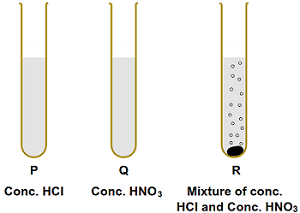
In an experiment shown below, 2 mL of each of the following acids were taken in test tubes labelled P, Q and R. A small piece of metal was added to each test tube. No reaction occurred in test tubes P and Q, but the metal dissolved in test tube R. Which of the following could be the metal?
Answer: (d) Au
In a reaction between elements A and B, A loses electrons, and B gains electrons to form compound C. Based on the nature of compound C, which of the following properties is least likely to be shown by it? 1. Has a low melting point. 2. Exists as a gas at room temperature. 3. Has a high melting point. 4. Conducts electricity in the molten state.
Answer: (a) 1 and 2
The electronic configurations of three elements X, Y, and Z are: - X: 2, 8 - Y: 2, 8, 7 - Z: 2, 8, 2 Based on their electronic configurations, which of the following statements regarding their properties is correct?
Answer: (d) Y is a non-metal and Z is a metal.
| Topic | Quiz |
|---|---|
| Cell, Life Cycles, Reproduction and Development | Quiz on Cell, Life Cycles, Reproduction and Development |
| Chemical Changes, Combustion and Reactions | Quiz on Chemical Changes, Combustion and Reactions |
| Ecosystem and Environmental Contamination | Quiz on Ecosystem and Environmental Contamination |
| Chemical and Magnetic Effects of Electric Current | Quiz on Chemical and Magnetic Effects of Electric Current |
| Energy Transformation and Transfer | Quiz on Energy Transformation and Transfer |
| Force, Pressure and Friction | Quiz on Force, Pressure and Friction |
| Light and Sound | Quiz on Light and Sound |
| Physical States and Changes in Matter | Quiz on Physical States and Changes in Matter |
| Metals and Non-Metals | Quiz on Metals and Non-Metals |
| Micro-organisms | Quiz on Micro-organisms |
| Earth, Stars and the Solar System | Quiz on Earth, Stars and the Solar System |
| Endocrine System, Hormones and Circulatory Systems in Animals | Quiz on Endocrine System, Hormones and Circulatory Systems in Animals |