Get ahead of the competition! Practice with this free quiz on Light and Sound for UGSO Class 8. Begin your practice now.
Which of the following correctly explains why sound waves cannot travel through space?
Answer: (b) Space lacks a medium for sound wave vibrations
Two students argue about why the sky looks red during sunset. One says it’s due to scattering, while the other says it’s due to refraction. Who is correct?
Answer: (c) Both are correct, but scattering plays a dominant role
In a dark room, a person sees a sudden bright flash of light. Which part of the eye will react first, and what will it do?
Answer: (c) Iris; It contracts the pupil to reduce light entry.
A music producer is designing a new speaker system. What should they do to ensure the bass (low-frequency sounds) is heard clearly?
Answer: (b) Use larger speakers that can amplify long wavelengths
Two students argue about the loudness of sound. One says it depends on frequency, while the other claims it depends on amplitude. Who is correct and why?
Answer: (b) The second student is correct because greater amplitude means higher energy.
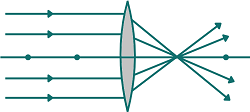
An object is placed at infinity in front of a convex lens. Where will the image be formed and what will be its characteristics?
Answer: (d) At the focus (F), real, inverted, and highly diminished
A photographer adjusts the focal length of a camera lens to capture a distant mountain. She later brings the camera closer to a flower and readjusts the lens to focus on it. What adjustment did she make to focus on the flower compared to the mountain?
Answer: (d) She moved the lens farther from the image sensor
An elderly person struggles to read small letters in a book when holding it close, but can see distant objects clearly. He visits an eye doctor and is advised to use convex lenses. Which of the following statements best explains his condition?
Answer: (c) He has presbyopia, caused by reduced flexibility of the eye lens due to aging.
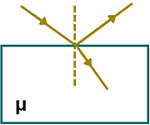
A light ray enters a glass slab of refractive index 1.5 at an angle of 30°. A part of the ray is refracted inside, while another part is reflected back into the air. What will be the angle of reflection for the reflected ray?
Answer: (a) 30°
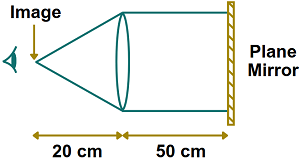
A convex lens of focal length 20 cm is placed 50 cm in front of a plane mirror. An object is positioned 40 cm in front of the convex lens. Which of the following statements is/are correct? 1. The final image is real and inverted. 2. The image formed by the lens alone is at 40 cm behind the lens. 3. If the distance between the lens and the mirror is reduced to 30 cm, the final image position remains unchanged.
Answer: (a) 1 and 2 only
| Topic | Quiz |
|---|---|
| Cell, Life Cycles, Reproduction and Development | Quiz on Cell, Life Cycles, Reproduction and Development |
| Chemical Changes, Combustion and Reactions | Quiz on Chemical Changes, Combustion and Reactions |
| Ecosystem and Environmental Contamination | Quiz on Ecosystem and Environmental Contamination |
| Chemical and Magnetic Effects of Electric Current | Quiz on Chemical and Magnetic Effects of Electric Current |
| Energy Transformation and Transfer | Quiz on Energy Transformation and Transfer |
| Force, Pressure and Friction | Quiz on Force, Pressure and Friction |
| Light and Sound | Quiz on Light and Sound |
| Physical States and Changes in Matter | Quiz on Physical States and Changes in Matter |
| Metals and Non-Metals | Quiz on Metals and Non-Metals |
| Micro-organisms | Quiz on Micro-organisms |
| Earth, Stars and the Solar System | Quiz on Earth, Stars and the Solar System |
| Endocrine System, Hormones and Circulatory Systems in Animals | Quiz on Endocrine System, Hormones and Circulatory Systems in Animals |