Time is critical! Get comprehensive free quiz practice on Ecosystem and Environmental Contamination for UGSO Class 8. Begin practicing today.
Which of the following statements about groundwater contamination are true? 1. Groundwater contamination is irreversible. 2. Nitrates from fertilisers can leach into groundwater. 3. Groundwater near landfills often contains heavy metals. 4. Contaminated groundwater can lead to eutrophication in lakes.
Answer: (c) 2, 3, and 4
Complete the flowchart for the impact of pesticides on a food chain: Pesticides applied to crops → Runoff into water bodies → ? → Bioaccumulation in top predators.
Answer: (a) Uptake by aquatic organisms
Over the last 200 years, global warming has been linked to significant changes in Earth's environment. Which of the following is identified as the primary cause of global warming during this period?
Answer: (d) Industrialisation and burning of fossil fuels.
Ecological sustainability refers to meeting the needs of the present without compromising the environment for future generations. Which of the following best describes ecologically sustainable development?
Answer: (c) It can be maintained indefinitely without degrading the ecosystem.
Which of the following is a true statement about the oxygen cycle?
Answer: (b) The ocean is a major reservoir of dissolved oxygen.
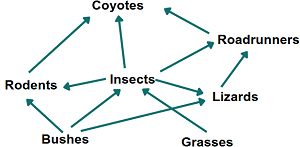
The diagram below represents a food web in a desert ecosystem. Which statement best describes a relationship within this food web?
Answer: (a) Coyotes depend indirectly on grasses and bushes for energy.
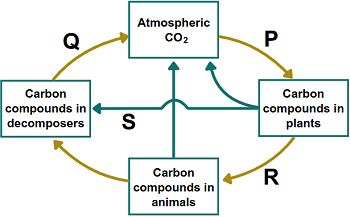
The diagram illustrates part of the carbon cycle. Which process is responsible for converting the largest amount of carbon from one form to another?
Answer: (a) P
In the following question, you will find an assertion and a reason. Select the appropriate option that applies. Assertion (A): Energy transfer between trophic levels in an ecosystem is inefficient. Reason (R): Only 10% of energy is passed to the next trophic level, with the rest lost as heat or used in metabolic processes.
Answer: (a) Both A and R are correct, and R is the correct explanation of A.
A population of zebra mussels, a non-native species, was accidentally introduced into a freshwater lake. The native species of mussels in the lake are now struggling to survive. Which factor is most likely allowing the zebra mussels to outcompete the native mussels? A. Zebra mussels have no natural predators in the lake. B. Zebra mussels reproduce faster than native mussels. C. Zebra mussels can attach to more surfaces and occupy more habitats.
Answer: (d) A, B and C
A truck transporting a highly volatile toxic chemical veers off a bridge and crashes into a large lake, causing the entire load to spill into the water. The chemical, known for its rapid evaporation and potential to form harmful vapours, poses immediate risks to aquatic life and the surrounding environment. Based on this information, answer the following question: Which factor is most directly reduced by the high volatility of the chemical?
Answer: (b) Its persistence in the environment
| Topic | Quiz |
|---|---|
| Cell, Life Cycles, Reproduction and Development | Quiz on Cell, Life Cycles, Reproduction and Development |
| Chemical Changes, Combustion and Reactions | Quiz on Chemical Changes, Combustion and Reactions |
| Ecosystem and Environmental Contamination | Quiz on Ecosystem and Environmental Contamination |
| Chemical and Magnetic Effects of Electric Current | Quiz on Chemical and Magnetic Effects of Electric Current |
| Energy Transformation and Transfer | Quiz on Energy Transformation and Transfer |
| Force, Pressure and Friction | Quiz on Force, Pressure and Friction |
| Light and Sound | Quiz on Light and Sound |
| Physical States and Changes in Matter | Quiz on Physical States and Changes in Matter |
| Metals and Non-Metals | Quiz on Metals and Non-Metals |
| Micro-organisms | Quiz on Micro-organisms |
| Earth, Stars and the Solar System | Quiz on Earth, Stars and the Solar System |
| Endocrine System, Hormones and Circulatory Systems in Animals | Quiz on Endocrine System, Hormones and Circulatory Systems in Animals |