Earth is made up of different layers: crust, mantle, outer core, and inner core. The crust is the outermost layer where we live. Natural resources like air, water, soil, minerals, and forests are found on Earth. These resources are essential for the survival of all living beings. Learning about Earth's structure and natural resources helps us understand how our planet is formed. This Earth Quiz for Grade 4 checks your knowledge regarding the importance of conserving resources and protecting the environment. Answer these 10 questions to see how much you know about Earth's structure and natural resources.
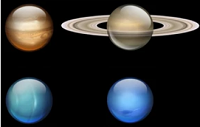
A spacecraft travels to each of the gas giants (Jupiter, Saturn, Uranus, Neptune). Which planet would be the hardest to explore in terms of distance and cold?
Answer: (d) Neptune
What is the main difference between a meteor and a meteoroid?
Answer: (d) A meteoroid is a small rock in space, and a meteor is the streak of light when it enters Earth's atmosphere.
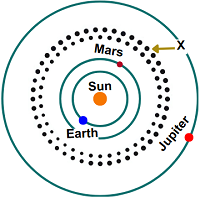
Identify the 'label X' in the diagram provided, which is an object in space is often found between planets and is made mostly of metal and rock, with no atmosphere.
Answer: (a) Asteroid
Imagine Earth is moved closer to the Sun, taking the place of Venus. What is the most likely change in Earth's environment?
Answer: (c) Earth would become much hotter, and water would evaporate.
A student compares two celestial bodies. Which of these is likely a star and why? Feature Celestial Body A Celestial Body B Produces its own light Yes No Has an atmosphere No Yes
Answer: (a) Celestial Body A, because stars produce their own light
Match the planet to its unique feature. Planet Feature A) Venus 1) Has a giant red spot (storm) B) Earth 2) Known for its rings C) Jupiter 3) Has an atmosphere of mostly carbon dioxide D) Saturn 4) The only planet with liquid water on its surface
Answer: (a) A-3, B-4, C-1, D-2
Imagine astronauts discover a planet where one day lasts as long as one Earth year. Which of the following is most likely true about that planet?
Answer: (b) It spins very slowly on its axis.
Look at the following statements about comets: 1. Comets are made mostly of ice, dust, and rocky material. 2. They orbit the Sun in a long, elliptical path. 3. Comets are visible only when they are close to the Sun. Which of the following statements best explains why comets are visible from Earth? .
Answer: (b) They reflect sunlight, making them visible in the night sky.
You are studying the planets and their rings. You observe the following facts: 1. Jupiter's rings are made of tiny rocks and ice. 2. Saturn's rings are large and made of ice particles. 3. Uranus and Neptune have faint rings made of dark material. Why do you think Saturn's rings are larger and brighter than Jupiter's?
Answer: (c) Saturn's rings reflect more sunlight.
During winter, you can see the constellation Orion in the sky. However, by summer, Orion is no longer visible. How can you explain this change in what we see in the sky?
Answer: (b) Earth's orbit around the Sun changes our view of the night sky.
| Topic | Quiz |
|---|---|
| Animal Biology | Quiz on Animal Biology |
| Earth's Structure and Natural Resources | Quiz on Earth's Structure and Natural Resources |
| Energy | Quiz on Energy |
| Food and Nutrition | Quiz on Food and Nutrition |
| Force and Motion | Quiz on Force and Motion |
| Human Body | Quiz on Human Body |
| Machines | Quiz on Machines |
| Materials and Solutions | Quiz on Materials and Solutions |
| Measurement | Quiz on Measurement |
| Plant Biology | Quiz on Plant Biology |
| Solar System and Space | Quiz on Solar System and Space |