The human body is made up of various systems that work together to keep us alive and healthy. The skeletal system gives structure, the muscular system helps us move, and the nervous system controls our actions. Other systems, like the digestive, respiratory, and circulatory systems, also play vital roles. Learning about the human body helps us understand how different organs function and support each other. Ace the preparation with this well-designed quiz on the human body for grade 4. It also teaches us how to maintain our health through proper nutrition and exercise. Answer these 10 questions to test your understanding of the human body and its systems.
Which of the following is an example of force causing an object to change direction?
Answer: (d) A kite turns and moves with the wind
When you push a sled on snow, it moves more easily compared to pushing the same sled on grass. What do you think is happening here?
Answer: (c) Snow reduces friction more than grass does.
When you push a soft clay ball into a flat surface, which of the following describes the effect of your force?
Answer: (d) The shape of the clay ball changes, flattening out as the force is applied.
Which of these is a harmful effect of friction?
Answer: (c) It causes the soles of shoes to wear out.
A book placed on a table does not move because:
Answer: (b) The table applies an upward force balancing the book’s weight.
A student investigates the effect of different lubricants on reducing friction between two metal surfaces. The table below shows the time taken for a sliding block to stop after being pushed. Which conclusion is valid based on the experiment? Lubricant Time to Stop (seconds) No Lubricant 5 Oil 10 Grease 12
Answer: (c) Grease reduces friction more effectively than oil.
You are pushing a heavy crate across a wooden floor, and it’s very hard to move. If you add a thin layer of water under the crate, how will the movement change?
Answer: (b) It will become easier to push because water reduces friction
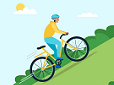
A child is riding a bike on a flat road. The child pedals harder to speed up. Which of the following changes would make it harder for the child to continue pedalling at the same speed?
Answer: (a) The road becomes steeper and the child is riding uphill
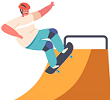
A skateboarder is riding on a ramp. If they jump off the ramp and land on a soft, sandy beach, how will the force of landing on sand compare to landing on hard concrete?
Answer: (a) The force from the sand will stop the skateboarder faster
Emily conducted an experiment using three different objects of the same size: a wooden block, a rubber ball, and a plastic cup. She placed each object at the top of a ramp and let them slide down the ramp. She observed how far each object travelled after sliding off the ramp. Based on the experiment, which of the following statements is/are correct? A: The rubber ball travels the smallest distance. B: The frictional force acting on the wooden block is greater than the frictional force acting on the rubber ball. C: The plastic cup moves a shorter distance than the rubber ball because it is hollow.
Answer: (d) B and C only
| Topic | Quiz |
|---|---|
| Animal Biology | Quiz on Animal Biology |
| Earth's Structure and Natural Resources | Quiz on Earth's Structure and Natural Resources |
| Energy | Quiz on Energy |
| Food and Nutrition | Quiz on Food and Nutrition |
| Force and Motion | Quiz on Force and Motion |
| Human Body | Quiz on Human Body |
| Machines | Quiz on Machines |
| Materials and Solutions | Quiz on Materials and Solutions |
| Measurement | Quiz on Measurement |
| Plant Biology | Quiz on Plant Biology |
| Solar System and Space | Quiz on Solar System and Space |