
The solar system consists of the Sun and all the objects that move around it, including eight planets, moons, asteroids, and comets. Earth is the third planet from the Sun and the only one with life. Space is the vast area beyond Earth where stars, galaxies, and other celestial bodies exist. Learning about the solar system and space helps us understand our place in the universe. This Solar System quiz for grade 4 aims to check how much you know about the movement of planets, the passage of day and night, and the seasons. Take this quiz with 10 questions to check your knowledge about the solar system and space.
Look at the diagram of a plant leaf. Identify the correct name for the labelled parts (A, B, C, D).
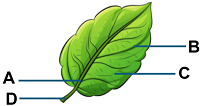
Answer: (c) A: Midrib, B: Veins, C: Lamina, D: Petiole
Plants use sunlight, carbon dioxide, and water during photosynthesis. What is the primary food molecule they produce that provides energy for growth and survival?
Answer: (d) Sugar (glucose)
Why do flowers have adaptations like bright colours and strong scents?

Answer: (c) To attract insects and animals that assist in pollination
A student places a white carnation flower in a jar of water with red dye. After a few hours, the petals turn red. Below are possible explanations for what happened. Which explanation uses evidence from the experiment and supports how the plant's parts work together?

Answer: (d) The red dye moves through the stem, showing that the stem transports water to the petals.
A farmer notices that the leaves of his plants are turning yellow and wilting. He waters the plants every day but wonders if something else is affecting their health. Which of the following could be the most likely reason for the plants’ poor health?
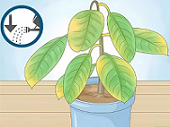
Answer: (a) The plants are getting too much water and may be drowning, which affects their roots.
Below is a flowchart showing how a student grouped different plant products into categories. Based on the flowchart, which of the following criteria is most likely used for the grouping?
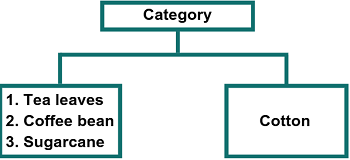
Answer: (a) Whether the product is used as a fibre or food.
Look at the picture of the plants growing. These plants have special adaptations to survive in the harsh environment. Based on the following adaptations, can you identify these plants? 1. The plants have small, thick leaves to reduce water loss. 2. The plants are low-growing and have a compact shape to resist strong winds. 3. The roots are shallow but spread wide to absorb water quickly from the thin, rocky soil. Which type of plants do you think these are?
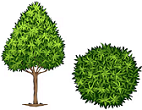
Answer: (c) Alpine plants
A farmer plants seeds in good soil with water and sunlight, but some of them do not sprout. After observing, the farmer notices that the seeds were planted at different depths. What could be the most likely reason the seeds did not sprout?
Answer: (a) The seeds planted too deep could not reach the surface to grow.
Consider the passage given below and answer the following question: The Amazing Power of Photosynthesis Plants are amazing! They don't need to eat food like animals do. Instead, they make their own food through a process called photosynthesis. This happens in the leaves of plants, where tiny structures called chloroplasts work hard to produce food. The process uses sunlight, carbon dioxide from the air, and water from the soil. Sunlight is like the energy that powers the process, and chloroplasts are like tiny factories that turn sunlight into food for the plant. During photosynthesis, plants also produce oxygen, which is very important for all living things on Earth. The oxygen is released into the air, which humans and animals need to breathe. Without photosynthesis, there wouldn't be enough oxygen for animals to survive. It also helps the plant grow and stay healthy by providing the nutrients it needs. Photosynthesis also plays a key role in the Earth's environment. When plants take in carbon dioxide, they help reduce the amount of this gas in the air. Carbon dioxide is a gas that can cause the Earth to get warmer if there's too much of it. By removing some of it, plants help keep our planet's climate stable. Now, think about how important photosynthesis is for not just the plants, but also the entire world. If plants didn’t make food and oxygen, life on Earth would be very different. Every living thing depends on the energy from the sun that plants capture and turn into food, making photosynthesis an essential process for life on Earth. After reading about photosynthesis, which of the following conclusions can be most accurately drawn about the importance of this process to life on Earth?
Answer: (b) Photosynthesis is essential for creating food for plants, oxygen for animals, and balancing carbon dioxide levels in the atmosphere.
Consider the passage given below and answer the following question: The Journey of a Seed When a seed begins its journey to become a new plant, it starts by germinating. Germination is the process where a seed starts to grow into a new plant. It requires three key things: water, air, and warmth. First, the seed needs water to soften its hard outer shell, which allows the seed to begin to grow. Without water, the seed would remain dormant and unable to sprout. Next, air is crucial for germination. Inside the seed, there is stored energy that the seedling needs to grow, and this energy is unlocked with the help of oxygen. The seed absorbs oxygen from the air, and this process helps the seed use its stored food to develop. If the seed is in a place with no air, it won't be able to grow, no matter how much water it has. Warmth is also essential for the seed to begin germinating. Seeds like warm temperatures to start their growth. When the temperature is too cold, the seed remains inactive and does not begin the sprouting process. Warmth activates the enzymes inside the seed that start the process of growth. Some seeds even require specific temperatures to germinate, which is why different plants sprout at different times of the year. Once the seed gets enough water, air, and warmth, it can sprout and start growing into a plant. The seed sends out tiny roots to find more water and nutrients, while the stem pushes up to get sunlight. These initial stages of growth are crucial for the plant's survival as it moves from being a small seed to a young plant ready to grow into a full-fledged adult plant. A farmer plants seeds in the soil and waters them, but the temperature remains too low for the seeds to germinate. What action could the farmer take to help the seeds germinate?
Answer: (b) Move the seeds to a warmer environment.