Measurement is the process of finding the size, length, weight, or quantity of something. We use standard units like meters for length, kilograms for weight, and litres for volume. Measuring helps us compare objects and solve problems in daily life. Tools like rulers, weighing scales, and measuring cups are used for measurement. Learning about measurement helps us understand how to measure accurately and convert units. It also improves our problem-solving skills in science and mathematics. Answer these 10 questions to test how well you understand measurement and units.
Which statements about the states of matter are correct? A. Solids have a definite shape and definite volume. B. Liquids can take the shape of their container but have a definite volume. C. Gases have a fixed shape and volume. D. The particles in solids are closely packed and do not move freely.
Answer: (c) A, B, and D only
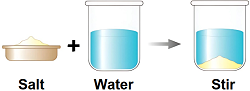
When you add more salt to an already saturated saltwater solution, what happens to the extra salt?
Answer: (d) It settles at the bottom
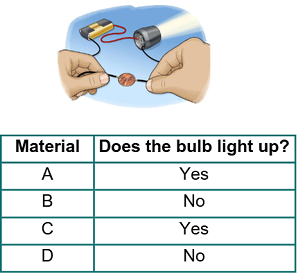
Tom conducted an experiment to find out how well four different materials, A, B, C, and D, allow electricity to pass through them. He used a simple circuit as shown. The table below shows whether the bulb lit up or not when each material was placed in the circuit. Based on the table, which one of the following statements is true?
Answer: (d) Material D may be wood.
Maria experimented to observe the changes in four different substances: wax, iron, baking soda, and water. She heated each substance and noted the following observations. Which of the following correctly states the types of change that are taking place? S.No Substance Change Observed A Wax Melts and can be solidified again B Iron Rusts when exposed to air and water C Baking Soda Reacts with vinegar and produces gas D Water Boils and turns into steam
Answer: (a) A- Physical change B- Chemical change C- Chemical change D- Physical change
Sarah experimented with four different types of cups (plastic, glass, metal, and paper). She filled each cup with the same amount of warm water and measured the time it took for the water to cool down to room temperature. The results were recorded in the table below. If Sarah were to conduct the experiment in a colder environment, like a freezer, how might the results change for each material? Material Cooling Time in Freezer (minutes) Cooling Time in Room Temperature (minutes) Plastic 10 30 Glass 8 20 Metal 5 15 Paper 12 35
Answer: (a) The cooling time for all materials would decrease due to the colder environment.
Sophie is conducting an experiment to investigate how different amounts of sugar dissolve in water at various temperatures. She uses three beakers labelled A, B, and C, each containing 100 ml of water. She records her observations after stirring different amounts of sugar into the water. Based on the table, which of the following statements is most likely true? Beaker Temperature of Water (°C) Amount of sugar added (g) Time Taken for Sugar to Dissolve (min) A 20°C 10 5 B 40°C 10 3 C 60°C 5 1
Answer: (b) The sugar in beaker C dissolved the fastest because the water was at the highest temperature.
In a science class experiment, Jayden mixed oil and water in a container and observed that the oil floated on top of the water. Why does oil float on water rather than mix with it?
Answer: (c) Oil is less dense than water.
Consider the passage given below and answer the following question: The Mystery of Solutions Every day, we use solutions without even thinking about them. Whether it's the sugar in our tea, salt in our soup, or the salt water we use to clean wounds, solutions are a big part of our lives. A solution is made when one substance dissolves completely into another. When you stir sugar into a glass of water, the sugar disappears and mixes evenly with the water. This happens because the sugar particles are small enough to spread throughout the water, creating a uniform mixture. The water is the solvent in this case, and the sugar is the solute. However, not all substances dissolve easily. For example, if you try to mix sand in water, the sand doesn't dissolve. Instead, it just settles at the bottom of the glass. This is because the particles of sand are too large and heavy to spread out in the water. Substances like sand, oil, and rocks are called insoluble because they do not dissolve in water. But the type of liquid can change whether a substance dissolves or not. Salt, for instance, dissolves easily in water, but if you try to dissolve it in oil, it won't work. Some liquids, like alcohol or vinegar, can dissolve different substances that water can't. This shows how solvents play an important role in how substances dissolve. So next time you stir your sugar into tea or salt into soup, remember that you're using a solution, and each substance has its way of interacting with the liquid. Which of the following examples shows that a substance has dissolved completely to form a solution?
Answer: (b) Chocolate powder in milk
Consider the passage given below and answer the following question: The Secrets of Everyday Materials Have you ever wondered why some materials are better at keeping you warm, while others seem to let the cold right in? Materials we use in everyday life all have unique properties that make them suitable for different tasks. These properties are revealed in interesting ways, especially when materials are heated, cooled, or used to block out sound. Consider metals. When a metal pot is heated, it conducts heat quickly, making it ideal for cooking. However, if you touch a metal spoon left in a hot pot, it might burn your hand! Metals are known for their ability to transfer heat, which is why they are commonly used in cookware. But what happens when metals are cooled? Many metals become brittle, making them easier to snap or break under sudden pressure, especially in very cold weather. Then there are materials like rubber and foam, which behave very differently from metals. Rubber doesn’t conduct heat well, making it a poor choice for cooking, but it’s excellent at stopping sound. Foam, with its spongy texture, is often used in soundproofing walls because it absorbs sound vibrations rather than letting them pass through. Unlike metals, these materials don’t change as much when heated or cooled, which is why they are often used in insulation. Glass, on the other hand, can change drastically. If you heat a glass bottle and then plunge it into ice water, it will likely shatter. This is because glass expands when heated and contracts when cooled very quickly, leading to cracks and breaks under sudden temperature changes. Despite this, glass is a great material for windows, letting in light but also acting as a barrier to certain sounds, though not as effective as foam or rubber. Materials like plastic are also interesting because they can take many forms and are versatile in everyday life. Plastics may melt and reshape when heated, making them ideal for moulding into new products. However, they lose flexibility once they cool down and harden, making them sturdy but fragile under pressure. This is why plastics are common in household items but less useful where strength is needed, like in construction. Why might foam be used in a recording studio, based on its properties?
Answer: (b) It absorbs sound vibrations, preventing echoes and outside noise.
Consider the passage given below and answer the following question: The Secrets of Everyday Materials Have you ever wondered why some materials are better at keeping you warm, while others seem to let the cold right in? Materials we use in everyday life all have unique properties that make them suitable for different tasks. These properties are revealed in interesting ways, especially when materials are heated, cooled, or used to block out sound. Consider metals. When a metal pot is heated, it conducts heat quickly, making it ideal for cooking. However, if you touch a metal spoon left in a hot pot, it might burn your hand! Metals are known for their ability to transfer heat, which is why they are commonly used in cookware. But what happens when metals are cooled? Many metals become brittle, making them easier to snap or break under sudden pressure, especially in very cold weather. Then there are materials like rubber and foam, which behave very differently from metals. Rubber doesn’t conduct heat well, making it a poor choice for cooking, but it’s excellent at stopping sound. Foam, with its spongy texture, is often used in soundproofing walls because it absorbs sound vibrations rather than letting them pass through. Unlike metals, these materials don’t change as much when heated or cooled, which is why they are often used in insulation. Glass, on the other hand, can change drastically. If you heat a glass bottle and then plunge it into ice water, it will likely shatter. This is because glass expands when heated and contracts when cooled very quickly, leading to cracks and breaks under sudden temperature changes. Despite this, glass is a great material for windows, letting in light but also acting as a barrier to certain sounds, though not as effective as foam or rubber. Materials like plastic are also interesting because they can take many forms and are versatile in everyday life. Plastics may melt and reshape when heated, making them ideal for moulding into new products. However, they lose flexibility once they cool down and harden, making them sturdy but fragile under pressure. This is why plastics are common in household items but less useful where strength is needed, like in construction. Max is choosing a material for the window of his birdhouse. He wants the window to let in light while keeping the cold out. Below is a table comparing three materials. Based on the information in the table, which material would be the best choice for Max’s window? Material Lets in Light Keeps the Cold Out Durability in Cold Weather Material A Yes Poor Can crack Material B Yes Good Stays strong in cold Material C No Excellent Very strong but cold to touch
Answer: (b) Material B, because it lets in light and keeps the cold out better than Material A.
| Topic | Quiz |
|---|---|
| Animal Biology | Quiz on Animal Biology |
| Earth's Structure and Natural Resources | Quiz on Earth's Structure and Natural Resources |
| Energy | Quiz on Energy |
| Food and Nutrition | Quiz on Food and Nutrition |
| Force and Motion | Quiz on Force and Motion |
| Human Body | Quiz on Human Body |
| Machines | Quiz on Machines |
| Materials and Solutions | Quiz on Materials and Solutions |
| Measurement | Quiz on Measurement |
| Plant Biology | Quiz on Plant Biology |
| Solar System and Space | Quiz on Solar System and Space |