
Electricity is a form of energy resulting from the flow of electric charge. It powers most modern devices and systems. Electric current is the flow of electrons through a conductor. It is measured in amperes. A circuit is a closed path through which electric current flows. Basic components of a circuit include a power source like a battery, conductors like wires, a load like a bulb, and a switch to control the flow. This Quiz on Electricity for Class 7 examines these fundamental concepts and circuit configurations in detail. Circuits can be series circuits where components are connected end-to-end, or parallel circuits where components are connected across common points. Understanding electricity and circuits helps students learn how electrical appliances work, the concept of resistance, and the importance of electrical safety. Take these 10 multiple-choice questions to assess your understanding of electricity and circuits.
Which of the following statements is correct? A) A fuse wire thickens when too much current flows. B) The fuse breaks the circuit by melting its wire. C) A fuse allows extra current to flow. D) Fuses are used to increase the current in a circuit.
Answer: (b) B only
State true or false: 1. All electric cells can be recharged. 2. Button cells are best suited for high-power devices like electric bikes. 3. Solar cells work even without sunlight by storing energy. 4. A dry cell is a type of primary cell that contains a chemical paste instead of a liquid.
Answer: (d) 1 - False, 2 - False, 3 - False, 4 - True
Four students (Anya, Max, Nick, and Kev) made circuits using a cell, bulb, switch, and wires. Their observations: Anya: Bulb did not glow; switch was ON; wires tightly connected. Bilal: Bulb glowed only when he pressed the switch. Hirat: Bulb glowed when connected, but dimmed quickly. Kev: Bulb glowed brightly for a long time. Who most likely had a broken cell or weak power source?
Answer: (c) Nick
A student sets up a simple electric circuit with a battery, a bulb, and two connecting wires. She places different materials between the open ends of the wires, one at a time, to check whether the bulb glows or not. She records the following observations, Fill in the correct predictions (Yes/No) for whether the bulb will glow when each material is used. Choose the most appropriate options. Material Inserted Will the Bulb Glow? (Yes/No) Steel Spoon ? Plastic Straw ? Wet Sponge ? Cotton Thread ?
Answer: (a) Yes, No, Yes, No
Which of the following are correct in terms of switch behavior in a circuit? A. A switch in OFF position completes the circuit but limits the voltage. B. A circuit with a faulty switch can behave as an open circuit even if the switch appears ON. C. An electric switch can be used to regulate the amount of current flowing through the circuit. D. A switch ON in a series circuit allows the same current to flow through all devices in that path.
Answer: (d) B and D
A student is trying to light up a bulb using a battery and a wire. The bulb does not light up. Find the flaw in his circuit.

Answer: (c) The electric circuit is incomplete.
Read the statement and the reason carefully and choose the correct option. Statement: A dry cell cannot be recharged and reused like a lead-acid battery. Reason: Dry cells are primary cells, while lead-acid batteries are secondary cells.
Answer: (a) Both Statement and Reason are correct, and Reason is the correct explanation.
Read the statement and the reason carefully and choose the correct option. Statement: A zinc-carbon cell used in a torch cannot be used to start a car engine. Reason: Zinc-carbon cells provide high voltage but cannot deliver large amounts of current required by car engines.
Answer: (c) Statement is correct, but Reason is incorrect
Observe the following diagram of a circuit carefully. If Bulb B is removed from the circuit, what will happen?
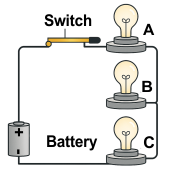
Answer: (c) All bulbs will turn off.
Riya replaces the button cell in her digital wristwatch. The watch works perfectly for a few days, but then the display suddenly turns blank, even though the buttons still make beeping sounds. The switch and display connections are intact. What is the most likely reason for this behavior?
Answer: (b) The cell's voltage dropped too low to power the display