Materials around us are made of different substances with varying properties. To use materials effectively, we often need to separate mixtures into their components. Separation techniques depend on the physical properties of the substances such as size, solubility, density, and magnetic properties. Common methods of separation include handpicking for large impurities, threshing for separating grains, winnowing for separating lighter particles, sieving for different-sized particles, sedimentation and decantation for insoluble solids in liquids, filtration for fine insoluble particles, evaporation for dissolved solids, and using magnets for magnetic materials. This Quiz on Sorting and Separation of Materials for Class 7th examines these practical techniques and their everyday applications. These methods are used in everyday life and industries. Learning about sorting and separation of materials helps students understand practical applications of physical properties and develop problem-solving skills. Answer these 10 multiple-choice questions to test your knowledge of separation techniques.
Which of the following statements are correct about compounds? A) Compounds always contain only one type of element. B) Compounds can be separated into their elements by physical methods like filtering. C) Compounds have properties different from the elements that form them. D) Compounds are formed by random mixing of elements in any proportion.
Answer: (d) C only
A farmer accidentally mixed wheat grains with dried leaves and small stones. He wants to separate the useful grains from the unwanted materials using the least effort. What is the best sequence of separation methods he should follow?
Answer: (c) Winnowing → Sieving → Hand-picking
A scientist is testing three different separation techniques for an insoluble solid-liquid mixture. The results are: Method X: The solid settles at the bottom after 30 minutes. Method Y: A porous material is used to separate the solid from the liquid. Method Z: The mixture is spun at high speed to separate components. Which statement correctly identifies the methods?
Answer: (b) X – Sedimentation, Y – Filtration, Z – Centrifugation
A chemical engineer is designing a separation system for a mixture of petrol, diesel, and water. Which of the following is the best method for separating all three liquids efficiently?
Answer: (b) Use a separating funnel for water and fractional distillation for petrol and diesel.
Four teams were given instructions to prepare sugar solutions. Only one team’s method could possibly result in a supersaturated solution. Which team prepared it correctly?
Answer: (d) Added 40 g sugar to 100 mL boiling water, dissolved it completely, and left it undisturbed to cool.
Which of the following statements is incorrect about separation techniques? 1. Evaporation can be used to obtain pure sugar crystals from sugar solution. 2. Crystallisation provides a better purity of solid than evaporation. 3. Crystallisation involves slow cooling of a saturated solution. 4. Evaporation leaves behind impurities along with the solid.
Answer: (a) 1 only
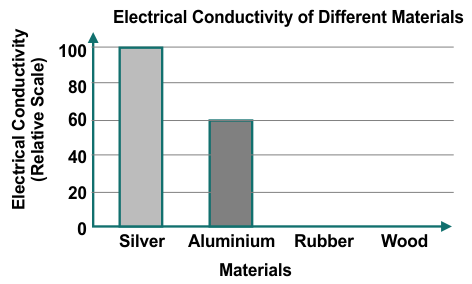
A graph shows the electrical conductivity of four materials. Which material has the lowest electrical resistivity?
Answer: (c) Silver
Which of the following scenarios incorrectly applies the method used?
Answer: (b) Using sedimentation to separate milk from cream
Match the separation method with the scientific principle it is based on: Separation Method Scientific Principle 1 Fractional Distillation a Difference in densities 2 Separating Funnel b Difference in boiling points 3 Centrifugation c Difference in solubility 4 Decantation d Difference in rotational force
Answer: (a) 1-b, 2-a, 3-d, 4-c
Which of the following correctly matches all the techniques? Mixture Method 1 Method 2 1 Sand + Saltwater Filtration (A) Evaporation (P) 2 Oil + Water Distillation (B) Separating Funnel (Q) 3 Muddy Water Filtration (C) Sedimentation (R) 4 Alcohol + Water Magnetic Separation (D) Distillation (S)
Answer: (d) 1-A-P, 2-B-Q, 3-C-R, 4-D-S
| Topic | Quiz |
|---|---|
| Human Body and Health | Quiz on Human Body and Health |
| Natural Resources and Calamities | Quiz on Natural Resources and Calamities |
| Earth and Universe | Quiz on Earth and Universe |
| Food and Its Component | Quiz on Food and Its Component |
| Fibre to Fabric | Quiz on Fibre to Fabric |
| Sorting and Separation of Materials | Quiz on Sorting and Separation of Materials |
| Matter and Changes Around Us | Quiz on Matter and Changes Around Us |
| Living Organisms and Their Surroundings | Quiz on Living Organisms and Their Surroundings |
| Motion and Measurement of Distances | Quiz on Motion and Measurement of Distances |
| Light, Shadows and Reflection | Quiz on Light, Shadows and Reflection |
| Electricity and Circuits | Quiz on Electricity and Circuits |
| Fun with Magnets | Quiz on Fun with Magnets |
| Our Environment | Quiz on Our Environment |