Light is a form of energy that enables us to see objects. It travels in straight lines and at an extremely high speed. Objects that emit their own light are called luminous objects, like the sun and bulbs, while objects that do not emit light are non-luminous, like the moon and furniture. When light falls on an opaque object, it cannot pass through, creating a dark area called a shadow. Shadows are formed because light travels in straight lines. This Light, Shadow, and Reflection Class 7 Quiz explores these optical phenomena and how light behaves with different surfaces. Reflection is the bouncing back of light when it strikes a surface. Mirrors reflect light and form images. Smooth surfaces cause regular reflection, while rough surfaces cause diffuse reflection. Learning about light, shadows, and reflection helps students understand optical phenomena and how we perceive the world. Take these 10 questions to test your knowledge.
A scientist designs an anti-glare coating for car windshields. The coating ensures that incoming light does not cause excessive brightness and discomfort for the driver. Which of the following scientific principles is MOST IMPORTANT in designing this coating?
Answer: (b) Diffused reflection
Pick the odd one out from the following.
Answer: (d) A glow-in-the-dark sticker
An astronaut on the Moon observes Earth completely blocking the Sun. What type of eclipse is this, and what part of the shadow is the astronaut in?
Answer: (a) Lunar eclipse, umbra
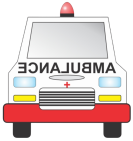
A student sees a mirrored word on an ambulance and wonders why it appears reversed. Which of the following concepts explains this phenomenon?
Answer: (d) Lateral inversion
A light ray strikes a plane mirror at an angle of 35° to the normal. What will be the angle between the incident ray and the reflected ray?
Answer: (c) 70°
Which of the following statements about reflection of light is incorrect? 1.The image formed in a plane mirror is always real. 2. The second law of reflection states that the incident ray, reflected ray, and normal lie in the same plane. 3. Diffused reflection follows the laws of reflection but does not produce a clear image. 4. Regular reflection in plane mirrors can produce vertically inverted images.
Answer: (a) 1 and 4 only
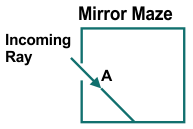
A ray of light 'A' enters a mirror maze having all the walls made of mirror as shown in the diagram. It strikes the first mirror at an angle of 45° and ray reflects from it and continues reflecting inside. What will be the direction of the ray 'A' after two reflections?
Answer: (b) Opposite direction (←)
A team of architects is designing an outdoor stadium where shadow patterns need to be considered for spectator comfort. They notice that shadows under large floodlights appear fuzzy rather than sharp. To minimise this effect and provide clear shade, what should they do?
Answer: (c) Use multiple small light sources instead of one large source
A scientist is conducting an experiment with a plane mirror. They place a candle 30 cm in front of the mirror and observe its image. The scientist then moves the candle 10 cm closer to the mirror. What will be the new distance of the image from the mirror?
Answer: (a) 20 cm
A scientist observes a spaceship in deep space, far from any stars or other light sources. The spaceship is painted completely black with no reflective surfaces. If an astronaut inside the spaceship turns on a flashlight, what will happen?
Answer: (b) The light will travel indefinitely, but the spaceship itself will remain invisible.
| Topic | Quiz |
|---|---|
| Human Body and Health | Quiz on Human Body and Health |
| Natural Resources and Calamities | Quiz on Natural Resources and Calamities |
| Earth and Universe | Quiz on Earth and Universe |
| Food and Its Component | Quiz on Food and Its Component |
| Fibre to Fabric | Quiz on Fibre to Fabric |
| Sorting and Separation of Materials | Quiz on Sorting and Separation of Materials |
| Matter and Changes Around Us | Quiz on Matter and Changes Around Us |
| Living Organisms and Their Surroundings | Quiz on Living Organisms and Their Surroundings |
| Motion and Measurement of Distances | Quiz on Motion and Measurement of Distances |
| Light, Shadows and Reflection | Quiz on Light, Shadows and Reflection |
| Electricity and Circuits | Quiz on Electricity and Circuits |
| Fun with Magnets | Quiz on Fun with Magnets |
| Our Environment | Quiz on Our Environment |