Motion is the change in position of an object with respect to time. Objects can move in a straight line, a circular path, or periodic motion. To describe motion accurately, we need to measure distances and time. The standard unit of distance is the metre, and the standard unit of time is the second. Various instruments like metre scales, measuring tapes, and odometers are used to measure distances. This Motion Quiz helps students understand the principles of kinematics and the importance of accurate measurement. The speed of an object is the distance travelled per unit time. Motion can be slow or fast, uniform or non-uniform. In ancient times, people used body parts and natural objects to measure lengths, but standard units provide consistency and accuracy. Learning about motion and measurement helps students understand kinematics, develop measurement skills, and appreciate the importance of standard units. Take these 10 questions to test your understanding.
Identify the correct answer from the hints: This type of motion occurs when different parts of an object move at varying distances from a central axis, while the object itself remains stationary.
Answer: (c) Rotational motion
Which of the following statements are incorrect about periodic motion? A) A pendulum always swings with increasing speed. B) Periodic motion repeats at regular intervals. C) The swing in a playground is a form of periodic motion. D) Periodic motion has no specific starting point.
Answer: (d) A and D
An astronaut carries a toolbox with a mass of 20 kg on Earth. She takes it to the International Space Station. She notices that the toolbox floats, but still feels some effort is required to stop or move it. What is the best explanation of this observation?
Answer: (b) The weight of the toolbox is zero in space.
A tailor uses a sewing machine to stitch a shirt. Which of the following correctly represents the combination of motions involved in the functioning of the sewing machine's needle and the wheel?
Answer: (b) Needle – Oscillatory + Periodic, Wheel – Rotational
You are given three objects to measure their masses: Object A: A fruit (apple) Object B: A small metal piece Object C: A book Which of the following devices is best suited for measuring the mass of each object?
Answer: (c) An electronic balance for Object A and Object B, and a beam balance for Object C
Which of the following statements about oscillatory and periodic motion are correct? 1. All periodic motions are oscillatory motions. 2. All uniform motions are periodic motions. 3. A child rocking on a swing is an example of both oscillatory and periodic motion. 4. The motion of a clock's second hand is periodic but not oscillatory.
Answer: (c) 3 and 4
Match the type of motion with its characteristics and examples: Column A – Type of Motion Column B – Combined Characteristics Column C – Real-World Application Example A) Translational + Curvilinear 1) Motion where all parts move same distance, but along a curved path a) A car turning along a curved flyover B) Oscillatory + Periodic 2) Repeats motion to and fro at fixed time intervals about a mean position b) A pendulum swinging in a clock C) Rotational + Periodic 3) Spinning around a fixed axis with equal time intervals per revolution c) Second hand of a clock D) Translational + Rectilinear 4) Body moves forward in a straight line without any rotation or curve d) Luggage moving on a straight airport conveyor belt
Answer: (a) A-1-a, B-2-b, C-3-c, D-4-d
A gymnast performing on a horizontal bar exhibits different types of motion. Identify the incorrect statement regarding her movements.
Answer: (d) When she jumps off the bar, she exhibits vibratory motion
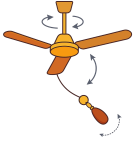
In the diagram, a ceiling fan is switched on, a keychain swings from one of its blades, and the fan rotates. Identify all types of motion occurring in the keychain.
Answer: (a) Circular + Periodic + Oscillatory
Lesley and John placed an irregularly shaped object on a graph paper with 1 cm² squares. The object covered 30 full squares and 10 partial squares, each approximately half-filled. Lesley calculated the area as 35 cm², while John calculated it as 40 cm². They were trying to estimate the area of a leaf for a biology project. Who is more accurate in estimating the area and why?
Answer: (a) Lesley is correct as she added only half of the partially covered squares.
| Topic | Quiz |
|---|---|
| Human Body and Health | Quiz on Human Body and Health |
| Natural Resources and Calamities | Quiz on Natural Resources and Calamities |
| Earth and Universe | Quiz on Earth and Universe |
| Food and Its Component | Quiz on Food and Its Component |
| Fibre to Fabric | Quiz on Fibre to Fabric |
| Sorting and Separation of Materials | Quiz on Sorting and Separation of Materials |
| Matter and Changes Around Us | Quiz on Matter and Changes Around Us |
| Living Organisms and Their Surroundings | Quiz on Living Organisms and Their Surroundings |
| Motion and Measurement of Distances | Quiz on Motion and Measurement of Distances |
| Light, Shadows and Reflection | Quiz on Light, Shadows and Reflection |
| Electricity and Circuits | Quiz on Electricity and Circuits |
| Fun with Magnets | Quiz on Fun with Magnets |
| Our Environment | Quiz on Our Environment |