
Animals are multicellular living organisms that depend on other organisms for food. They are found in diverse habitats such as forests, oceans, grasslands, deserts, and even polar regions. Animals are classified into different groups, like mammals, birds, reptiles, amphibians, fish, and insects, based on their body structure and characteristics. Some animals are domestic and live with humans, while others are wild and live in their natural habitats. This Quiz on Animals for Class 5 is designed to help students explore these classifications and characteristics in detail. Animals perform various activities such as feeding, breathing, moving, reproducing, and responding to their surroundings. They are an important part of the food chain and ecosystem. Learning about animals helps students understand biodiversity, adaptation, and the interdependence of life forms. Attempt these 10 multiple-choice questions to test your knowledge about animals.
Carlos saw a butterfly sitting on a flower. A few weeks later, he noticed caterpillars feeding on leaves in the same garden. Which stage must the butterfly have gone through to produce the caterpillars?

Answer: (a) Egg
Which of the following animals demonstrates an adaptation in its feeding behaviour to help it survive in its environment?
Answer: (c) Owl – hunts at night using silent flight to catch prey
A zookeeper places a camel, a penguin, and a frog in the same open-air enclosure in a warm city. After a week, only one is healthy. Which animal MOST LIKELY survived and why?
Answer: (c) Camel – used to harsh, dry climate
Read the statements and choose the correct option: 1. Invertebrates have no backbone. 2. All birds are invertebrates. 3. Fish are aquatic vertebrates. 4. Earthworms are invertebrates.
Answer: (c) 1, 3 and 4
Which animal is most likely to have the jaw shown in the image?
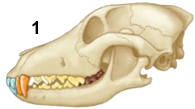
Answer: (d) Wolf
Below shows some key adaptations of four animals: L, M, N, and O. Based on the characteristics given, identify the correct match of each animal to its most likely habitat. 1. L - Thick, white fur 2. M- Prehensile tail 3. N- Webbed feet 4. O- Scaly skin, water-storing body Letter Habitat Animal(s) A Arctic L B Rainforest M C Aquatic N D Desert O
Answer: (a) A, B, C, and D
Four animals – P, Q, R, and S – have the following traits as shown in table below. Which of the following habitat matches is most appropriate for these animals? Animal Characteristics P Has thick fur, short ears, and stores fat under its skin. Q Has strong back legs, moist skin, and is usually active during or after rainfall. R Has curved claws for gripping branches, and its loud calls echo through dense greenery. S Has a white coat that changes with seasons, large paws, and excellent sense of smell.
Answer: (b) P – Desert, Q – Wetlands, R – Rainforest, S – Arctic
While exploring the deep sea, a robot camera recorded a strange fish with glowing parts near its mouth. The ocean around it was completely dark. Soon after, tiny fish began swimming toward the glow. What is the most likely reason the fish uses this glowing trick?
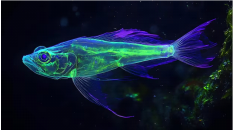
Answer: (d) To act like food and attract smaller fish to eat
Below is a simplified food web in a forest ecosystem. If pesticides kill almost all grasshoppers, what is the most likely chain reaction?
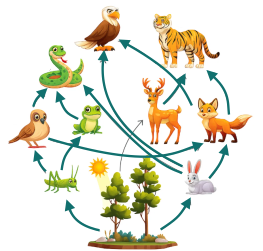
Answer: (b) Frogs starve, snakes decrease, hawks hunt more birds, deer increase
Select the ODD one out.
Answer: (a) Gills
| Topic | Quiz |
|---|---|
| Plants | Quiz on Plants |
| Animals | Quiz on Animals |
| Birds | Quiz on Birds |
| Housing and Clothing | Quiz on Housing and Clothing |
| Transport and Communication | Quiz on Transport and Communication |
| Human Body | Quiz on Human Body |
| Earth and Universe | Quiz on Earth and Universe |
| Matter and Material | Quiz on Matter and Material |
| Light and Sound | Quiz on Light and Sound |
| Our Environment | Quiz on Our Environment |
| Food and Digestion | Quiz on Food and Digestion |
| Force, Work and Energy | Quiz on Force, Work and Energy |