Plants are autotrophic organisms that produce their own food through photosynthesis using sunlight, water, and carbon dioxide. They release oxygen as a by-product, which is vital for the survival of living beings. Plants have specialised structures: roots absorb water and minerals from the soil, stems provide support and transport nutrients, leaves perform photosynthesis, flowers are involved in reproduction, and fruits protect and disperse seeds. This Quiz on Plants for Class 5 explores these structures and their functions in maintaining plant life. Plants are classified into various groups such as herbs, shrubs, trees, and creepers, based on their size and structure. They provide food, oxygen, shelter, medicine, and raw materials. Learning about plants helps students understand their life processes, diversity, and ecological significance. Try these 10 multiple-choice questions to evaluate your knowledge of plants.
Ryan observed water droplets on the tip of a leaf early in the morning, even though it hadn’t rained. Which process is most likely responsible for this?
Answer: (a) Transpiration
Match the plant example with its most likely stem feature. Plant Example Stem Feature 1 Mango tree a Thick and woody stem 2 Money plant b Weak stem that needs support 3 Rose plant c Many thin stems close to ground 4 Pumpkin plant d Grows along the ground
Answer: (a) 1-a, 2-b, 3-c, 4-d
Which of the following pairs correctly matches a plant type with its most typical adaptation?
Answer: (c) Fixed Plant – Long roots that anchor the plant to the bottom of a pond
Which of the following pairs is correctly matched with its seed dispersal method?
Answer: (d) Coconut - water
After a windy storm, Max noticed that many grass plants were pulled out easily, but the neem trees remained firmly rooted in the soil. Which of the following best explains this difference?
Answer: (d) Neem trees have taproots that anchor them deeply
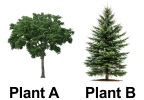
Look at the pictures below of two trees. What is the similarity in their leaf adaptations?
Answer: (a) Both help survive in cold and dry seasons
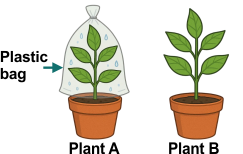
Two identical potted plants were placed in different conditions as shown. After 3 hours, Plant A’s plastic bag had water droplets inside. What does this observation prove?
Answer: (b) Water escapes from leaves during transpiration
Find the odd one out based on the type of plant product?
Answer: (c) Paper
Trees like pine and fir don’t shed all leaves together. But gulmohar and neem lose leaves in autumn. What is a correct comparison?
Answer: (d) Evergreen trees keep leaves year-round; deciduous shed them seasonally
A plant with small leaves and a thick stem grows in a mountain environment. It has a deep taproot. What could be the primary reason for its adaptations?
Answer: (b) To withstand high winds and low temperatures.
| Topic | Quiz |
|---|---|
| Plants | Quiz on Plants |
| Animals | Quiz on Animals |
| Birds | Quiz on Birds |
| Housing and Clothing | Quiz on Housing and Clothing |
| Transport and Communication | Quiz on Transport and Communication |
| Human Body | Quiz on Human Body |
| Earth and Universe | Quiz on Earth and Universe |
| Matter and Material | Quiz on Matter and Material |
| Light and Sound | Quiz on Light and Sound |
| Our Environment | Quiz on Our Environment |
| Food and Digestion | Quiz on Food and Digestion |
| Force, Work and Energy | Quiz on Force, Work and Energy |