
Mensuration is the branch of mathematics that deals with measuring the area, perimeter, and volume of geometric shapes and solids. It helps us solve practical problems like finding the size of land, the capacity of containers, or the material needed for construction. Understanding mensuration is useful in engineering, architecture, and everyday planning tasks. These Mensuration Grade 7 MCQ offer practice with formulas for various shapes and their applications. These 10 MCQs will allow students to evaluate their ability to calculate measurements for different shapes and solids.
The area of a rhombus is the square of 16. If the length of one of its diagonals is 8 cm, then what will be the length of the other diagonal?
Answer: (a) 64 cm
The perimeter of a square is half the circumference of a circle with a radius of x cm. Find the length of each side of the square.
Answer: (c) πx/4 cm
The non-parallel sides of a trapezium measure 12 cm and 17 cm. One of its parallel sides is 5 cm longer than the other, and its perimeter is 50 cm. Find the length of the larger parallel side.
Answer: (c) 13 cm
The perimeter of a rectangle, whose length is four more than twice its breadth, is 38 cm. Determine two-fifths of its area.
Answer: (b) 28 cm²
If the circumference of a circle is equal to 198 cm, then find one-seventh of its area.
Answer: (a) 445.5 cm²
Find the cost of painting the walls of a cubical room with each edge measuring 13 m at the rate of $3250 per 10 m².
Answer: (b) $219,700
In the given figure, PQRS is a square, where PS = 14 cm, PT = 6 cm, TQ = 8 cm and the area of the shaded region equals 80 cm². Determine the value of m.
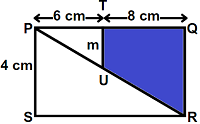
Answer: (c) 6 cm
Compute the perimeter of the given figure.
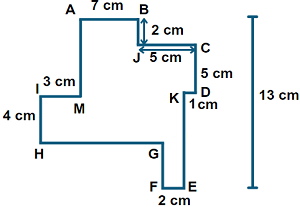
Answer: (d) 56 cm
A wire is initially shaped as a square with each side measuring 16 cm. If the same wire is reshaped into a right triangle, where the base and height are in the ratio of 5 : 12 and the third side measures 13 cm, determine the area of the triangle in m².
Answer: (c) 0.027 m²
Read the passage carefully and answer the following question. Two farmers, Peter and David, grow four types of vegetables, Type A, Type B, Type C and Type D, in their fields. Peter has a rectangular field and David has a circular field. Peter's field has a crosspath of width 6.5 m, where he cannot grow vegetables as shown in the figure. They both divide the cultivating area in their fields into four equal parts to grow each vegetable in an equal part of the field. The length and breadth of Peter's field are 50 m and 42 m, respectively. The radius of David's field is 7 m less than the breadth of Peter's field. What is the total area in Peter's field allocated for growing vegetables of Type A and Type D in hectares?
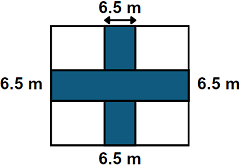
Answer: (d) 0.0772125 hectares
| Topic | Quiz |
|---|---|
| Algebraic Expressions | Quiz on Algebraic Expressions |
| Data Handling | Quiz on Data Handling |
| Simple Linear Equations | Quiz on Simple Linear Equations |
| Exponents and Powers | Quiz on Exponents and Powers |
| Fractions | Quiz on Fractions |
| Integers | Quiz on Integers |
| Mensuration | Quiz on Mensuration |
| Profit, Loss and Percentage | Quiz on Profit, Loss and Percentage |
| Ratio and Proportion | Quiz on Ratio and Proportion |
| Rational Numbers | Quiz on Rational Numbers |
| Symmetry and Visualising Solid Shapes | Quiz on Symmetry and Visualising Solid Shapes |
| Triangles | Quiz on Triangles |