Matter is anything that has mass and occupies space. It is made up of atoms and molecules. Matter exists in three primary states: solid, liquid, and gas. Each state has distinct properties based on particle arrangement and movement. Solids have tightly packed particles with fixed positions, liquids have particles that can move freely but remain close, and gases have widely spaced particles that move rapidly. This Matter and Materials for Class 6 quiz helps students understand the composition and properties of different substances. Materials are substances from which objects are made. They can be metals like iron and copper, non-metals like sulphur and carbon, or compounds like water and salt. Materials have properties such as density, hardness, melting point, and conductivity that determine their uses. Learning about matter and materials helps students understand the composition and behaviour of substances. Answer these 10 questions to assess your knowledge.
Two bottles of water are kept in different environments: Bottle X is kept in a freezer at -10°C. Bottle Y is kept in a freezer at -20°C. After 2 hours, which of the following statements is correct?
Answer: (b) Bottle Y froze faster with smaller ice crystals.
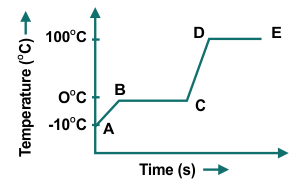
The graph shows temperature changes of water over time. Which section of the graph represents boiling?
Answer: (c) The horizontal line DE
A student notices that when she bends a metal spoon slightly, it comes back to its original shape. She says, "This means the spoon is not a solid because I could bend it." Why is her conclusion incorrect?
Answer: (a) Some solids are flexible but still keep their overall shape and volume.
Who among the following made the correct statement? Aria: “A solid cannot flow because its particles are packed so tightly that they can only vibrate in place.” Leo: “A solid flows slowly because its particles move randomly and have large gaps between them.”
Answer: (a) Aria is correct but Leo is incorrect.
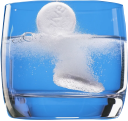
You drop a fizzy tablet into water and observe bubbles. The tablet dissolves and releases gas. Which conclusion is best?
Answer: (d) It is a chemical change because gas formation and a new substance occur.
A factory releases a liquid mixture of chemicals and water. They want to recover pure water and reuse it. Which separation technique is best and why?
Answer: (d) Distillation, because it separates substances based on boiling points
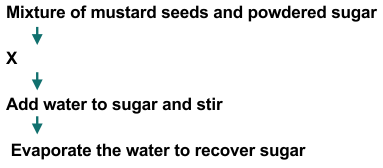
Look at the steps in separating technique. What is the best missing step (X)?
Answer: (c) Use sieve to separate components by size
A science lab is given three unknown white powders: Powder A disappears completely in water. Powder B forms a cloudy mixture and settles after 1 hour. Powder C bubbles when vinegar is added. Which pair of separation or identification methods would best classify all three correctly?
Answer: (d) Filtration and chemical reaction testing
Study the given table and select the option that best represents the headings X, Y, and Z:. Features X Y Z Can be separated by filtration Yes No No Can be separated by evaporation No Yes No Can be separated by sedimentation and decantation No No Yes
Answer: (a) X – Sand and Water, Y – Salt solution, Z – Muddy water
Four students were asked to identify the correct separation technique for an oil-water mixture. Who is correct? Alex: Filtration is the best method to separate oil from water. Maria: Decantation can be used to separate oil floating on water. John: Sedimentation helps to separate oil and water. Sophia: Distillation separates oil from water because they have different boiling points.
Answer: (b) Maria and Sophia
| Topic | Quiz |
|---|---|
| Plants | Quiz on Plants |
| Animals | Quiz on Animals |
| Food and Clothing | Quiz on Food and Clothing |
| Natural Resources and Calamities | Quiz on Natural Resources and Calamities |
| Matter and Materials | Quiz on Matter and Materials |
| Force, Work and Energy | Quiz on Force, Work and Energy |
| Our Environment | Quiz on Our Environment |
| Earth and Universe | Quiz on Earth and Universe |
| Human Body and Health | Quiz on Human Body and Health |