Plants are autotrophic organisms that synthesise their own food through the process of photosynthesis. They convert light energy into chemical energy stored in glucose. Plants absorb carbon dioxide from the atmosphere and release oxygen, making them essential for life on Earth. The structure of a plant includes roots for absorption and anchorage, stems for support and transport, and leaves for photosynthesis. Plants also have specialised tissues for conducting water and nutrients. This Quiz on Plants for Class 6 explores these structures and the various plant classification systems. Reproduction in plants occurs through seeds, spores, or vegetative parts. Plants are classified into groups such as algae, bryophytes, pteridophytes, gymnosperms, and angiosperms based on their structure and reproductive methods. Learning about plants helps students understand botany, ecology, and the importance of plant conservation. Take these 10 questions to test your knowledge of plants.
Consider the following statements. Choose whether they are TRUE or FALSE: 1. Some plants like money plant or pea have tendrils that help them climb and stay upright. 2. Cactus plants climb on nearby trees to get more sunlight. 3. Creepers usually grow along the ground as they cannot support their own weight. 4. Climbing plants are found only in forests and cannot grow in home gardens.
Answer: (b) 1 – True, 2 – False, 3 – True, 4 – False
Read the statements given below and answer the question that follows: Statement 1: Increasing the temperature to an ideal range helps plants perform photosynthesis better. Statement 2: Reducing the amount of sunlight exposure slows down photosynthesis. Which of the following is true about the above statements?
Answer: (c) Both statements are correct
Look at the pattern given below and identify 'X' correctly: Carbon dioxide : Required for Photosynthesis :: X : Byproduct of Photosynthesis
Answer: (a) Oxygen — because plants release oxygen while making their food using carbon dioxide and sunlight.
Consider the following statements and choose the correct option: Statement 1: Plant A has broad, waxy leaves that help it absorb water easily in the rainforest. Statement 2: Plant C has thick, fleshy stems and minimal leaves, which help it store water and reduce water loss in the desert.
Answer: (c) Statement 1 is incorrect but statement 2 is correct.
A pond plant reproduces by breaking off small parts of itself that float away and grow into new plants. This method helps the plant:
Answer: (a) Save energy used in growing flowers and fruits
Study the observations of two different plants that grow in nutrient-poor soils. Which of the following is the best explanation for the adaptations of both plants? Plant Observation Plant X Has leaves that snap shut when small insects land on them Plant Y Has long tube-like structures filled with fluid that drowns and digests small insects
Answer: (d) Both plants use specialized leaves to trap and digest insects to obtain nutrients missing in the soil.
Which of the following sets shows correct matches of plant type and its adaptation?
Answer: (c) Cactus – spines instead of leaves, desert
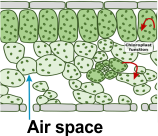
Look at the cross-section of a floating leaf. The leaf has large air spaces inside. What is the MAIN purpose of these air spaces?
Answer: (b) To allow the leaf to float on water
Read the assertion and the reason provided, choose the correct answer: Assertion (A): Cactus plants have reduced or no leaves. Reason (R): This helps them photosynthesize faster in desert heat.
Answer: (d) A is true, but R is false
A gardener places seeds of two different plants in identical soil conditions. One seed germinates quickly, while the other takes much longer. What is the most likely explanation for the difference in germination time?
Answer: (b) The slower-germinating seed has a thicker seed coat that prevents water absorption.
| Topic | Quiz |
|---|---|
| Plants | Quiz on Plants |
| Animals | Quiz on Animals |
| Food and Clothing | Quiz on Food and Clothing |
| Natural Resources and Calamities | Quiz on Natural Resources and Calamities |
| Matter and Materials | Quiz on Matter and Materials |
| Force, Work and Energy | Quiz on Force, Work and Energy |
| Our Environment | Quiz on Our Environment |
| Earth and Universe | Quiz on Earth and Universe |
| Human Body and Health | Quiz on Human Body and Health |