Health means our body and mind are in good condition. Hygiene refers to practices that keep us clean and prevent diseases. Washing hands, brushing teeth, bathing daily, and keeping our surroundings clean are all part of hygiene. Learning about health and hygiene helps us stay fit and free from illness. It also teaches us good habits that improve our quality of life. Hygiene is important at home, school, and in public places. Try these 10 questions to check how well you understand health and hygiene practices.
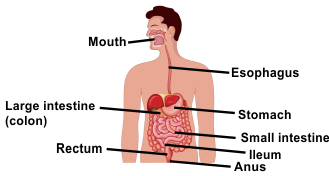
The following diagram shows the organs of the human digestive system. One organ uses strong acids to break down food into smaller pieces. Which organ is responsible for this first step?
Answer: (d) Stomach
Look at the following descriptions of parts of the circulatory system: Part 1: A blood vessel that carries oxygen-rich blood from the heart to different parts of the body. Part 2: A tiny blood vessel where oxygen and carbon dioxide are exchanged between blood and body cells. Which of these parts are arteries and which are capillaries?
Answer: (a) Part 1: Arteries, Part 2: Capillaries
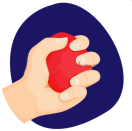
Sam squeezes a rubber ball continuously for 2 minutes. By the end of the experiment, his hand feels tired. What caused Sam’s hand to feel tired?
Answer: (b) The muscles in his hand used up too much energy.
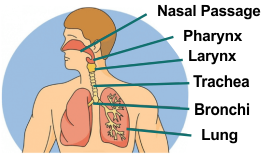
Look at the diagram of the human respiratory system below. Which statement best explains how the lungs help in breathing?
Answer: (d) The lungs are where oxygen from the air enters the body, and carbon dioxide is released.
Match the organ of the respiratory system with its function. Organ Function A. Nose 1. Helps push air in and out of the lungs when we breathe B. Windpipe 2. Filters and breathes air C. Lungs 3. Carries air to lungs D. Diaphragm 4. Exchanges oxygen and carbon dioxide with the blood
Answer: (b) A-2, B-3, C-4, D-1
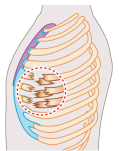
If a person’s ribcage were damaged, which of the following might happen?
Answer: (c) Their heart and lungs might be less protected.
Read the statements below about the muscular system and select the correct option. 1. Muscles help your body move by contracting and relaxing. 2. Muscles can grow when you stretch them too much. 3. All muscles are attached to bones, which helps in movement.
Answer: (c) Statement 2 is false
Carefully read the given passage and answer the following questions. The Body’s Lifeline for Blood and Health The circulatory system is responsible for transporting blood throughout the body. This system includes the heart, blood vessels, and blood. The heart is a muscle that pumps blood, the blood vessels are like highways that carry the blood, and blood is the liquid that carries oxygen, nutrients, and waste throughout the body. The circulatory system helps maintain the health of every organ and tissue, ensuring they get what they need to function. Without a healthy circulatory system, the body wouldn't be able to work properly. Identify the INCORRECT statement related to the circulatory system.
Answer: (c) The circulatory system does not help remove waste from the body.
Carefully read the given passage and answer the following questions. Muscles and Bones: The Dynamic Duo That Helps Us Move The muscular and skeletal systems work together to help us move, stand, and perform everyday activities. The skeletal system is made up of bones that give shape and support to our body. Some bones, like the skull, protect important organs like the brain. The ribcage protects the heart and lungs. Joints, where two bones meet, allow us to bend and move. Imagine you are designing a helmet for safety. What is the main reason to make the helmet strong?
Answer: (a) To protect the brain like the skull does
Carefully read the given passage and answer the following questions. Muscles and Bones: The Dynamic Duo That Helps Us Move The muscular and skeletal systems work together to help us move, stand, and perform everyday activities. The skeletal system is made up of bones that give shape and support to our body. Some bones, like the skull, protect important organs like the brain. The ribcage protects the heart and lungs. Joints, where two bones meet, allow us to bend and move. What will happen if a person’s bones were not strong enough to support their body?
Answer: (b) The muscles would take over and provide support instead.
| Topic | Quiz |
|---|---|
| All About Animals | Quiz on All About Animals |
| Health and Hygiene | Quiz on Health and Hygiene |
| Human Body | Quiz on Human Body |
| Light | Quiz on Light |
| Forms of Matter | Quiz on Forms of Matter |
| Natural Resources-Sun and Water | Quiz on Natural Resources-Sun and Water |
| Plants in the Surroundings | Quiz on Plants in the Surroundings |
| Sound | Quiz on Sound |
| Properties of Water | Quiz on Properties of Water |