Surface area is the total area of all the outer surfaces of a three-dimensional object, while volume is the amount of space it occupies. Calculating these measurements helps us solve practical problems involving containers, packaging, construction, and material usage. Understanding surface area and volume is important for geometry and has applications in engineering, architecture, and manufacturing. These Grade 9 surface area and volume MCQs provide practice with formulas for various three-dimensional solids. These 10 MCQs will allow students to assess their knowledge of formulas and their ability to apply them to different solids.
A rectangular piece of paper measuring 11 cm by 8 cm can be exactly wrapped to cover the curved surface of a cylinder of height 8 cm. What is the volume of the cylinder?
Answer: (b) 77 cm3
Find the percentage increase in the area of the triangle if each of its side is doubled.
Answer: (c) 300%
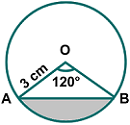
ACB is an arc of a circle of radius 3 cm. It subtends an angle of 120o at the centre, as shown in the figure. What is an area of the shaded portion ACB?
Answer: (a) (3π - 9√(3)/4) cm2
The length of the hypotenuse of a right-angled triangle is 13 cm, and its area is 30 cm2. Find the lengths of the remaining two sides.
Answer: (d) 5 cm, 12 cm
In a right-angled triangle ABC, D is the foot of the perpendicular from B on the hypotenuse AC. If AB = 3 cm and BC = 4 cm, what is the area of ΔABD?
Answer: (b) 54/25 cm2
A circle is inscribed in an equilateral triangle of side a cm. What is the area of any square inscribed in this circle?
Answer: (c) a2/6 cm2
A sphere and a cube have the same surface area. What is the ratio of the square of volume of the sphere to the square of volume of the cube?
Answer: (a) 6 : π
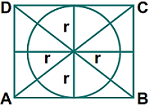
In a circular sheet of perimeter 2πr touching each side of a given quadrilateral sheet of perimeter 2p is cut off from the quadrilateral, then what is the area of the remaining sheet?
Answer: (b) r(p - πr) square units
Read the following passage and answer the following question: ABCD is a square with a side length of a cm. The sides AB, BC, CD, and AD are all chords of circles, each with the same radius. Each chord subtends an angle of 120° at the centre of its corresponding circle. Calculate the total area of the figure formed by the square and the four arcs.
Answer: (d) a2(1 + 4(π/9 - √3/4) square units
Read the following passage and answer the following question: ABCD is a square with the side length of a cm. The sides AB, BC, CD, and AD are all chords of circles, each with the same radius. Each chord subtends an angle of 120° at the centre of its corresponding circle. Find the volume of a cylindrical structure constructed by extruding this figure vertically by a height h.
Answer: (b) (a2h(1 + 4(π/9 - √3/4)) square units
| Topic | Quiz |
|---|---|
| Circles | Quiz on Circles |
| Coordinate Geometry | Quiz on Coordinate Geometry |
| Euclid's Geometry | Quiz on Euclid's Geometry |
| Heron's Formula | Quiz on Heron's Formula |
| Lines and Angles | Quiz on Lines and Angles |
| Linear Equations in Two Variables | Quiz on Linear Equations in Two Variables |
| Polynomials | Quiz on Polynomials |
| Probability | Quiz on Probability |
| Quadrilaterals | Quiz on Quadrilaterals |
| Rational and Irrational Numbers | Quiz on Rational and Irrational Numbers |
| Statistics | Quiz on Statistics |
| Surface, Area and Volume | Quiz on Surface, Area and Volume |
| Trigonometry | Quiz on Trigonometry |
| Triangles | Quiz on Triangles |