
Decimals are numbers that include a decimal point to represent parts of a whole, and they are used in measurements, money, and calculations. Understanding decimals helps students work with precision and connect the concept of fractions to practical situations. Decimals are essential in everyday life, from measuring distances to handling currency. The Decimal Quiz for Grade 6 provides comprehensive practice with decimal operations and real-world applications. By attempting these 10 MCQs, students can evaluate how confident they are in performing operations with decimal numbers.
Ivy started with $15. She donated 2/5 of this amount to a donation camp. After the donation, she gave her friend 1/4 of the remaining balance and spent $1.30 on a snack for herself. Find the remaining balance with Ivy.
Answer: (a) $5.45
If a decimal is 4.5 units to the left of zero on the number line and another decimal is 5.7 units to the right of zero on the number. What is the sum of these decimals?
Answer: (b) 1.2
Read the passage carefully and answer the following question: Robert commutes 80 miles each way to work every day. He takes three different forms of transportation to his office, as shown in the diagram below. Each mile on a bike costs three dollars, a bus costs two and a train costs one and a half dollars. What is the total cost of the train to the total cost of the bus for the complete journey?
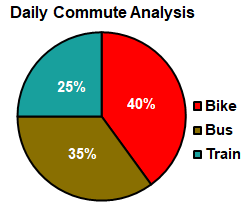
Answer: (c) $15/28
Read the passage carefully and answer the following question: Robert commutes 80 miles each way to work every day. He takes three different forms of transportation to his office, as shown in the diagram below. Each mile on a bike costs three dollars, a bus costs two and a train costs one and a half dollars. If Robert decides to travel the distance he travels by bike in the train then what is the total cost of the journey?
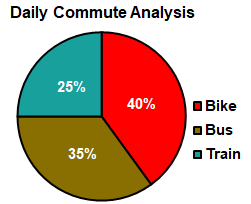
Answer: (d) $134
If 5 kg of sugar costs $16.5 and 2 boxes of sweets require 2.7 kg of sugar. Find the cost of the sugar required for 7 boxes of sweets to the nearest hundredth.
Answer: (c) $31.19
If a book costs $17.3 and 2 pens cost $7.5 then what digit is in the tenths position in the cost of 13 books and 5 pens?
Answer: (c) 6
A bus travels 76.2 km with 3 litres of petrol, a car travels 100.4 km with 4 litres of petrol, and a bike travels 160.5 km with 5 litres of petrol. Which of the following travels less with 1 litre of petrol?
Answer: (b) Car
Read the passage carefully and answer the following question: Ben's daily regimen consists of walking, jogging, and running respectively. If he walks at 3 kilometres per hour, jogs at 5 kilometres per hour, runs at 6 kilometres per hour and completes eight kilometres each day. The percentage of the distance he walks, jogs and runs is shown in the figure below. What is the time taken by the ben in hours to the nearest hundredths?
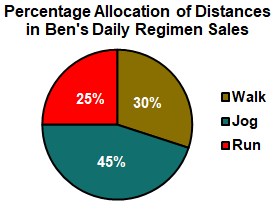
Answer: (a) 1.79
Arthur and Jack travel from their home to the farm which is 36 km away at speeds of 48 km/h and 60 km/h respectively. Find how much early in hours Jack reaches before Arthur.
Answer: (a) 0.15 hours
Read the passage carefully and answer the following question: Leach aspired to establish a business and, following the guidance of his uncle initiated a small bread factory. He recognized the importance of monitoring the factory's revenue to effectively plan for its future expansion. The sales and price of bread are shown in the given figure. What is the value of sales in April/ sales in March to the nearest hundredths?
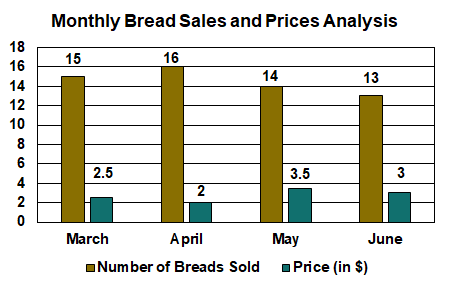
Answer: (d) $1.07
| Topic | Quiz |
|---|---|
| Algebraic Expressions | Quiz on Algebraic Expressions |
| Area, Perimeter and Volume | Quiz on Area, Perimeter and Volume |
| Comparing Quantities | Quiz on Comparing Quantities |
| Data Handling | Quiz on Data Handling |
| Decimals | Quiz on Decimals |
| Fractions | Quiz on Fractions |
| Basic Geometrical Ideas and Symmetry | Quiz on Basic Geometrical Ideas and Symmetry |
| Knowing Our Numbers | Quiz on Knowing Our Numbers |
| Understanding Elementary Shapes (2D and 3D Shapes) | Quiz on Understanding Elementary Shapes (2D and 3D Shapes) |