Circles are perfectly round shapes where every point on the boundary is equidistant from the center, and they have unique properties involving tangents, chords, and angles. Understanding the theorems related to circles is essential for solving geometric problems and proofs. This Circles Grade 10 MCQ explores these theorems and geometric properties in detail. Circles appear in nature, technology, and design, making this knowledge practically useful. These 10 MCQs will help students assess their understanding of circle properties and the theorems that govern them.
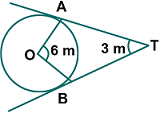
O is the centre of a circle. TA and TB are tangent to the circle. Find the value of m.
Answer: (a) 20o
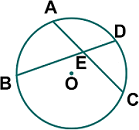
In the figure, O is the centre of the circle. AC⊥BD, AE = 5 cm, ED = 3 cm and EC = 8 cm. Find the radius of the circle.
Answer: (b) 8 cm
Two parallel chords in a circle have lengths of 30 cm and 40 cm. The radius of the circle is 25 cm. What is the distance between the two parallel chords?
Answer: (c) 5 cm
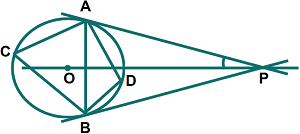
O is the centre of the circle and ∠OPA = 30°. Find ∠ACB and ∠ADB, respectively.
Answer: (a) 60o, 120o
Circles A, B and C are externally tangent to each other and internally tangent to the circle D. Circle C has radius 1 unit and passes through the centre of circle D. Then find the radius of circle B.
Answer: (b) 8/9 units
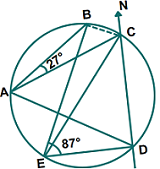
A, B, C, D and E are points on the circle. Point C is due north of Point D and Point E is due west of Point D. CAB = 27o. The angle of elevation of point B from point E is 87o. What is the angle of elevation of point B from point D?
Answer: (b) 63o
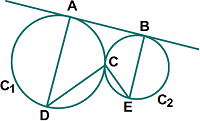
AB is the common tangent to the circles C1 and C2. C1 and C2 are touching externally at C. AD and DC are two chords of the circle C1 and BE and CE are two chords of the circle C2. Find the measure of ∠ADC + ∠BEC.
Answer: (d) 90o
In a circle with centre O and radius 13 cm, a chord AB is drawn. Tangents at A and B intersect at P such that ∠APB = 60°. If the distance of AB from the centre O is 5 cm, then what is the length of AP?
Answer: (c) 24 cm
ABCD is a cyclic quadrilateral such that when sides AB and DC are produced, they meet at E, and sides AD and BC meet at F, when produced. If ∠ADE = 80° and ∠AED = 50°, then what is the measure of ∠AFB?
Answer: (d) 30o
Let ABCD be a quadrilateral in which AB is parallel to CD and perpendicular to AD, AB = 3CD and the area of quadrilateral is 4 m2. If a circle can be drawn touching all the sides of the quadrilateral, then find the radius of the circle.
Answer: (b) √3/2 m
| Topic | Quiz |
|---|---|
| Area Related to Circles | Quiz on Area Related to Circles |
| A.P. and G.P. | Quiz on A.P. and G.P. |
| Circles | Quiz on Circles |
| Coordinate Geometry | Quiz on Coordinate Geometry |
| Linear Equations and Inequations | Quiz on Linear Equations and Inequations |
| Polynomials | Quiz on Polynomials |
| Quadratic Equations | Quiz on Quadratic Equations |
| Real Numbers and Logarithms | Quiz on Real Numbers and Logarithms |
| Statistics | Quiz on Statistics |
| Surface, Area and Volume | Quiz on Surface, Area and Volume |
| Trigonometry | Quiz on Trigonometry |
| Triangles | Quiz on Triangles |