
The Nile River, often regarded as the longest river in the world, has been a lifeline for the civilizations of northeastern Africa for thousands of years. It flows through several countries, providing water, transportation, and fertile soil to sustain agriculture. The Nile has played a key role in the development of ancient Egypt and continues to be a significant natural resource today. In this section, we will explore the Nile’s source, its journey, and how it has shaped human life.
The Nile River originates from two main sources:
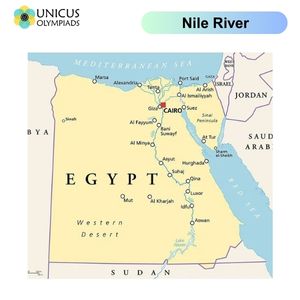
The Nile flows through eleven countries in northeastern Africa, including Uganda, Sudan, South Sudan, Ethiopia, Kenya, and Egypt, before it empties into the Mediterranean Sea. It spans a total distance of about 6,650 kilometers (4,130 miles), making it the longest river in the world. The river's flow is essential for the survival of millions of people who live along its banks.
The Nile has profoundly impacted the development of human civilization, especially in Egypt, where it has been central to agriculture, culture, and trade. Here are several ways the Nile has shaped human life:
The annual flooding of the Nile was crucial for agriculture in ancient Egypt. As the river overflowed its banks, it deposited nutrient-rich silt on the land, creating fertile soil that made agriculture possible in an otherwise desert region. This predictable flooding allowed Egyptians to grow crops like wheat, barley, and flax, supporting a growing population and enabling the rise of a powerful civilization.
The Nile River has always been a vital transportation route for people and goods. In ancient Egypt, boats were used to travel up and down the river, facilitating trade and communication between different regions.
The Nile played an important role in the religious and cultural life of ancient Egypt. The river was seen as a gift from the gods, and it was linked to several important deities in Egyptian mythology, such as Hapi, the god of the Nile, who was believed to control the annual flooding.
The Nile’s role in providing water, fertile soil, and transportation allowed early Egyptians to settle and form one of the world’s earliest civilizations. Cities and settlements developed along the river, becoming centers of culture, trade, and political power.
Today, the Nile continues to shape the lives of millions of Egyptians. It remains a critical water source for the country’s agriculture and industry, and it plays a key role in the economy. The construction of the Aswan High Dam in the 1960s has allowed Egypt to better control the river's flow and use it for irrigation, while also preventing flooding and producing hydroelectric power.